When I was a kid, backyard BBQ’s were a simple affair: frozen hamburgers, Oscar Meyer hot dogs, and pot-luck side dishes were about as elaborate as we’d get – and there’s nothing wrong with that. But now that I’m older and have a backyard of my own, I find myself wanting to put a more grown-up twist on my BBQ’s. I want to prepare food that my friends will remember and that will bring them back next summer. I’m talking about good quality food: gourmet burgers, interesting salads, and easy but fun desserts. So that’s what I’m cooking up for you this week! Continue reading
Category Archives: Main Dishes
Unbelievably Delicious Burgers for Your Next Backyard BBQ
A great BBQ requires more than just good friends and lively music to be a success. Seriously, you know and I know that everyone is really coming for the food, right? So let’s all agree that this summer we won’t settle for throwing frozen meat-pucks on the grill, instead, let’s mix up our own one-of-kind gourmet hamburger patties. Sound like a lot of work? It’s not. Creating the perfect burger is much easier than you’d think, all you have to do is remember these three simple rules… Continue reading
Stuff My Kid Eats: Smoked Salmon and Cream Cheese Frittata
As promised, here’s another creation from my Mother’s Day smoked salmon gift, this time coming to you in the form of a frittata. I just recently started making frittatas again after a couple year hiatus. I used to make them once a week when my husband and I were first married and had very little money. We called them “Frittata Fridays” because by the end of the week we’d be out of groceries, out of cash, and out of creative ides for dinner. The only thing we’d have left in the fridge were some eggs (which we somehow always had plenty of), a leftover piece of chicken or a few uneaten shrimp, and a couple of sad looking veggies in the crisper. Tired and discouraged, I’d whip everything up, throw it into the oven, and 20 minutes later we’d be sitting down to eat. Now no longer poor, (although still tired and sometimes discouraged), my love for frittatas was renewed when my daughter became a toddler. Her obsession with eggs (fried, scrambled, hard boiled, you name it!) made me want to cook up this old favorite and share it with her. I guess distance – and a picky toddler – makes the heart grow fonder. Continue reading
Smoked Salmon Focaccia with Asparagus & Eggs
I realize this is an old topic, but for Mother’s Day this year I was the fortunate recipient of a pound of smoked salmon from Dean & DeLuca (one of my favorite New York food purveyors). After a couple mornings of piling it on the obligatory bagel and cream cheese, I found myself wanting to do something more interesting with my catch — I was picturing something healthy that I could serve my family for dinner. As luck would have it, my weekend trip to the Kansas City farmers’ market left me with a loaf focaccia bread, a bunch of asparagus, and a dozen farm-fresh eggs that were just begging to be used. After quickly cooking the eggs and asparagus, I heaped everything onto the focaccia, shoved it in the oven for a couple minutes, and what came out was a light and fresh meal that was still substantial enough to require a fork and steak knife to eat.
Smoked Salmon Focaccia with Asparagus & Eggs
Serves 4
- 1 focaccia loaf
- ½ bunch of asparagus, tender parts only
- 4 large eggs
- 5-6 oz. smoked salmon, thinly sliced
- Kosher Salt and fresh cracked black pepper
- ¼ cup grated Parmesan cheese
- 2 Tbsp. fresh tarragon, chopped (or another fresh herb like dill, chives, parsley, or marjoram)
- 1 tsp. truffle oil (optional)
Turn oven on to 350°F. Place focaccia on a baking sheet and cook for 10 minutes or until focaccia is warm throughout. Remove from oven and set aside. Turn oven temperature up to broil.
Meanwhile, fill a medium saucepan halfway full of water and boil. Add asparagus and blanch for 1 minute. Immediately transfer asparagus to a bowl of ice water to stop the cooking. Once cool, dry and set aside.
Lay smoked salmon on focaccia, spreading evenly, then top salmon with a single row of asparagus.
Lightly mist a medium skillet with cooking spray then set over medium-high heat. Once the skillet becomes hot, crack eggs into skillet and cook until the whites just set (the eggs will continue cooking under the broiler). Using a spatula, carefully place eggs over asparagus. Season with salt and pepper and sprinkle with parmesan and chopped herbs. Place under the broiler and cook until cheese is bubbly, about 2-3 minutes (yolks should still be runny). Remove from oven and transfer to a serving platter, then drizzle with truffle oil if using.
Check back later this week for more smoked salmon recipes!
Stuff My Kid Eats: Beet Risotto
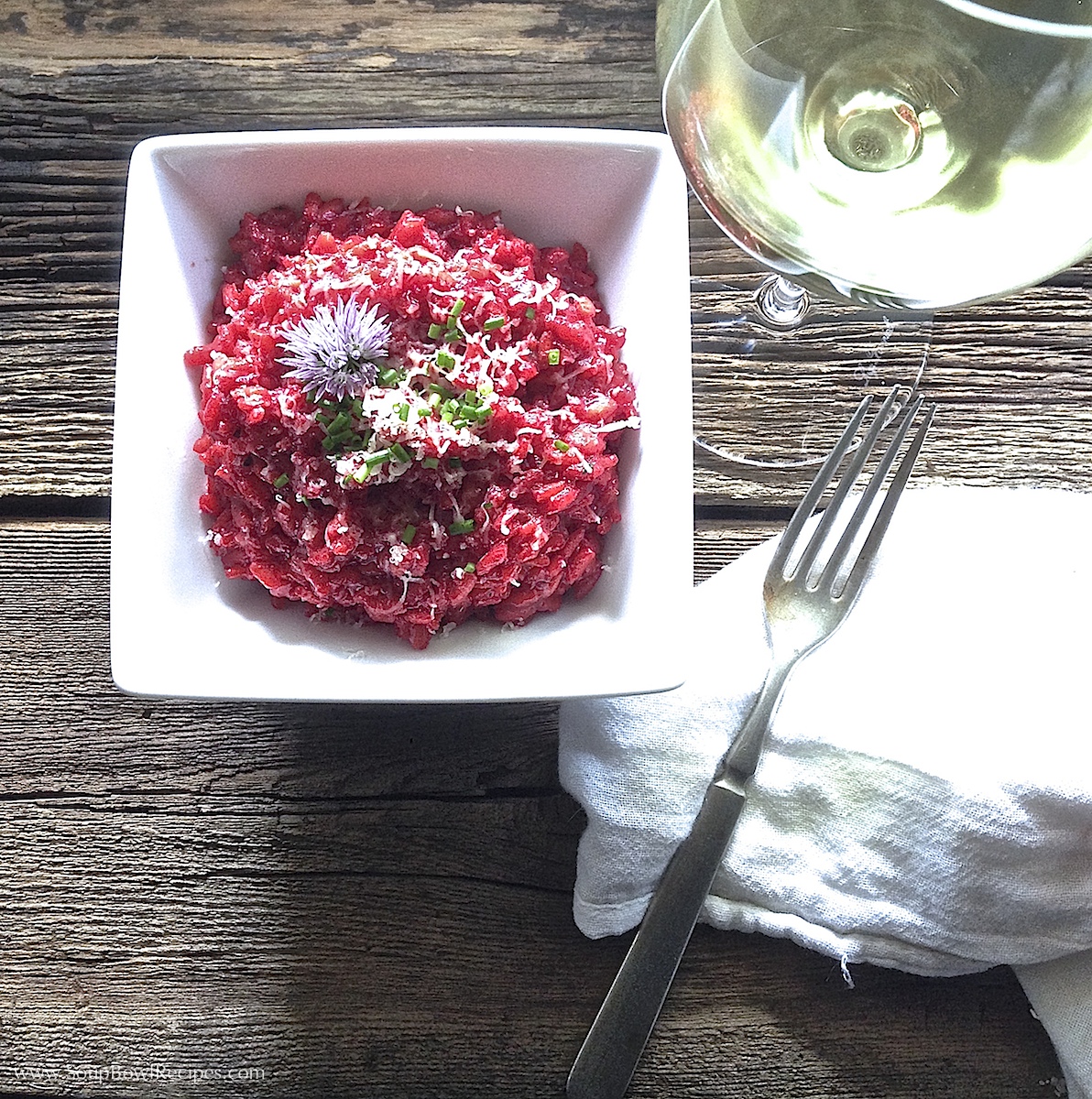
Beets are one of those things that people either love or hate, kind of like boy bands or the Twilight series. I, for one, am definitely in the “Team Beet” camp, and so is my toddler. I don’t know what it is about them, but they just scream summer to me. Maybe it’s because their smell reminds me of cut grass, or their bright color is worthy of a beach ball, but as soon as the weather starts getting warm, I crave them in my salads and pastas. I served this beet risotto to my family last week and when my toddler saw the colorful rice she said, “Oh Mommy, I’m going to eat all of my dinner tonight!” — and she did.
Beet Risotto
Serves 4
- 1 cup uncooked Arborio rice
- 3 Tbsp. olive oil, divided
- 2 Tbsp. unsalted butter
- 1 shallot, minced
- 2 cloves garlic, minced
- 4 cups fish stock, or chicken or vegetable stock (see recipe in Homemade Stocks)
- 1 roasted beet, coarsely chopped (*see How To)
- Kosher salt
- Fresh cracked black pepper
- 4-5 chives sprigs, chopped
- Fresh grated parmesan cheese for serving
In a food processor or blender add beet and 1 Tbsp. oil and blend until smooth, set aside.
In a saucepan, bring stock and wine to a low simmer. Meanwhile, over medium-low heat, melt butter and oil in a large straight-sided skillet until bubbly. Add shallots and cook until tender, about 3-4 minutes. Add risotto and garlic and cook for 1 minute, stirring occasionally.
Using a large soup ladle, pour 1 ladle-full (about ½ cup) of stock into risotto and stir until liquid is absorbed. Gradually stir in remaining broth 1 ladle-full at a time, cooking and stirring until liquid is absorbed before adding the next ladle. Continue this process until all but 1 ladle-full of stock has been used, approximately 25-30 minutes. Add the last ladle of stock with puréed beet, stir, then reduce heat to low and cook for 5 minutes, covered. Uncover and stir until all remaining liquid has evaporated, about 2-3 minutes. Season with salt and pepper, and garnish with a sprinkle of chives and grated parmesan.
*How to Roast a Beet:
Preheat oven to 350°F. Scrub beets clean, then wrap in tin foil. Place in oven and roast for 1 hour, or until easily pierced with a fork. Let cool, then peel with a vegetable peeler. Cut into ¼-inch cubes. Set aside. (I always roast about 3-4 beets at a time, then freeze the extra in a resealable plastic bag to use later, like in my Creamy Roasted Beet Soup.)
Tip: Beets can stain hands, clothing, cutting boards, and light-colored sinks and countertops. To avoid turning everything in your kitchen red, wear cooking gloves while handling beets, and peel over an open plastic bag set in the sink.
Sidekick: Serve with a chilled glass of Riesling, Chablis, Rosé, or Pinot Blanc.
Farmers’ Market Ratatouille
Hi, my name’s Emily and I am a farmers’ market junkie. No really, I have a serious problem. When May arrives and my local farmers’ market reopens for the summer, I visit every week. Sometimes twice. It takes me hours to peruse every stand and talk to every farmer. I usually spend way too much money buying way too much produce - more than my family could possibly eat in one week. When I get home I artfully arrange my trophies in cute little baskets on my countertop, and because I’m a total geek, I take pictures of my displays and text them to my husband with cheesy notes that say: “Look what’s cookin’ tonight!” or “Got Produce?” His replies go something like, “Um, that’s a lot of peppers, honey.” By the end of the week I’ve only used about half of what I bought, and I’m left with extremely ripe, eat-me-right-now veggies that are in threat of going to waste. Which is how I found my other addiction: ratatouille. This super healthy, one-pan meal uses up all my leftover odds-and-ends-produce, freeing up my counter for another visit to the market.
Farmers’ Market Ratatouille
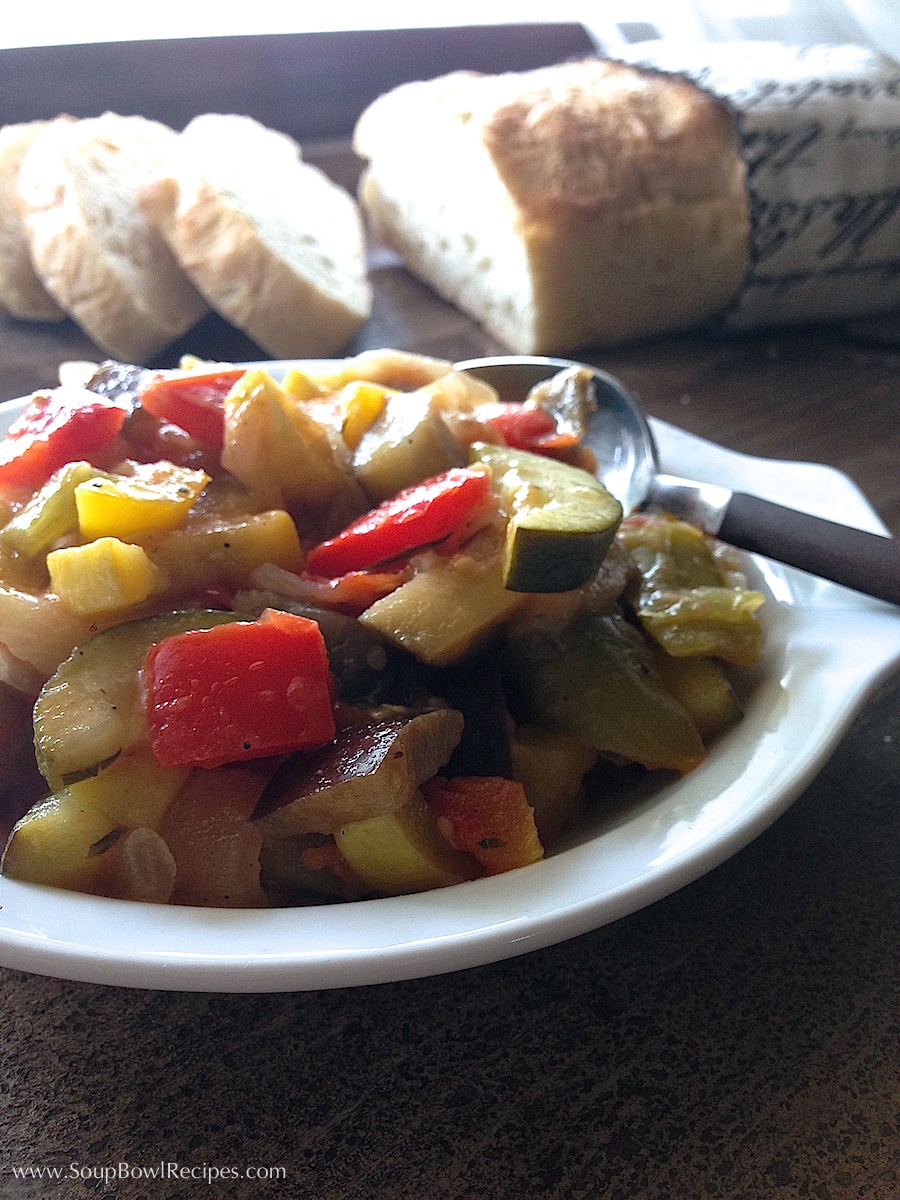
This vitamin-rich dish can serve as a vegetarian entrée (say on Meatless Monday), an accompaniment to grilled meat, or an easy sauce when thrown into a pot of cooked pasta. Sometimes I even spoon it over a slice of toasted baguette for a quick lunch.
Farmers’ Market Ratatouille
Serves 4 as an entrée or 6-8 as a side dish
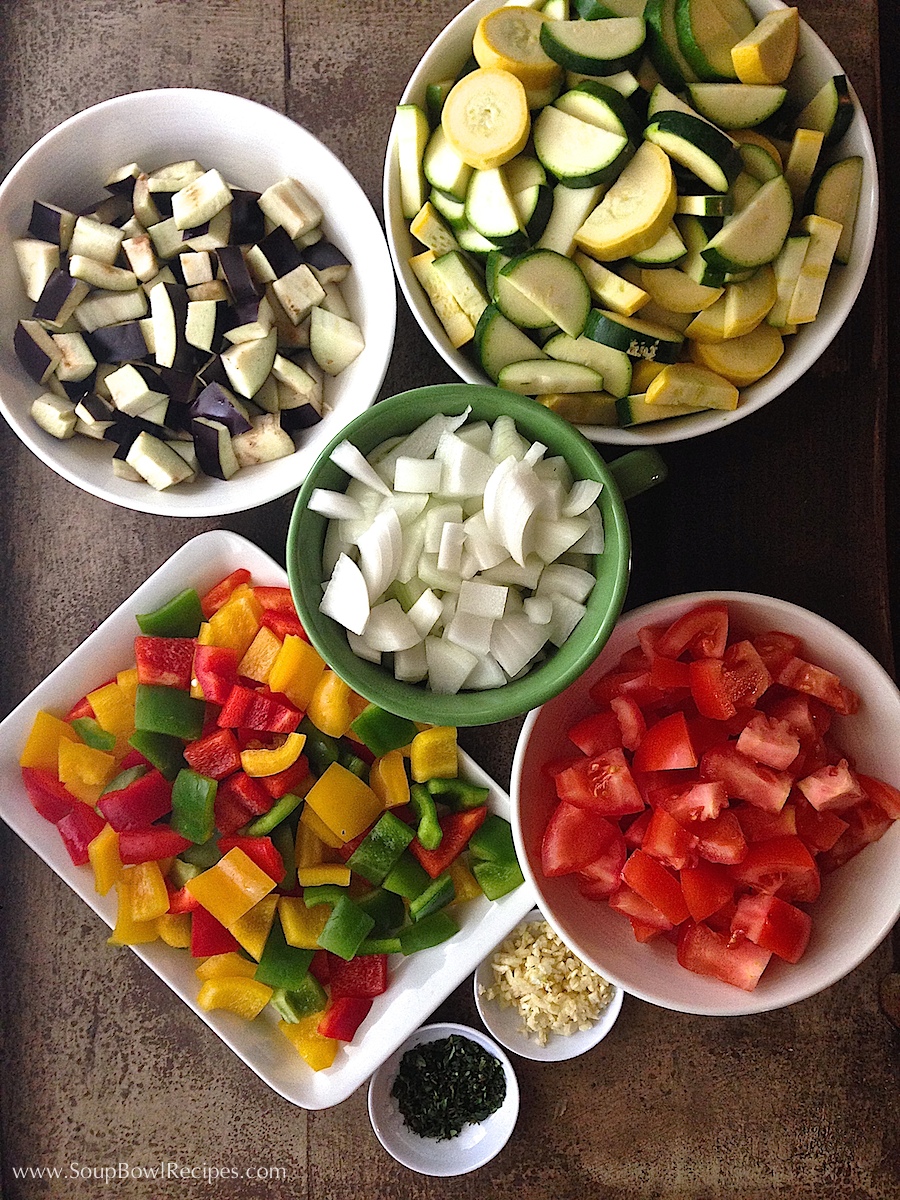
- 2 Tbsp. olive oil
- 1 yellow onion, diced
- 1 red bell pepper, diced
- 1 green bell pepper, diced
- 1 yellow bell pepper, diced
- 2 zucchini squash, diced
- 2 yellow summer squash, diced
- 1 small eggplant, skin on, diced
- 4 tomatoes, seeded
- 3 cloves garlic, minced
- 4 sprigs fresh thyme, minced (or another fresh herb such as oregano, basil, or parsley)
- Kosher salt
- Fresh crack black pepper
In a large straight-sided skillet set over medium-high, heat oil until shimmering. Add onions and peppers and cook, stirring occasionally, until they begin to soften. Add the garlic and cook until just fragrant, about 1 minute.
Add remaining ingredients to the pot, stirring and cooking for about 5 minutes. Turn the heat to low, cover pot, and cook, stirring occasionally, until everything has softened, about 30-40 minutes. Season with salt and pepper and serve with crusty bread to sop up all those lovely juices.
Local Farmers’ Markets
These days almost ever town in America has a weekly farmers’ market (typically open May through October). My local market runs twice a week during the summer, which is a great way to feed my addiction, but come December I start itching for a fix again. Thankfully, I’ve always lived within a stone’s throw of a major city that has a year-round farmers’ market. Usually housed in an permanent structure, these markets are just like the townie ones only on steroids. In addition to selling produce, farm-fresh eggs, and meats, many of these larger markets will offer an array of other attractions such as local cuisine, homemade soaps and lotions, art, flee market items, and rides & games for the kids. I’ve visited quite a few over the years, but my favorites are Pike Place Market in Seattle, Union Square Greenmarket in NYC, and City Market in Kansas City, MO, which I’ve visited a few times this season already…
*To find a farmers’ market in your area, click here.
Stuff My Kid Eats: Beer Can Chicken with Grilled Asparagus & Avocado
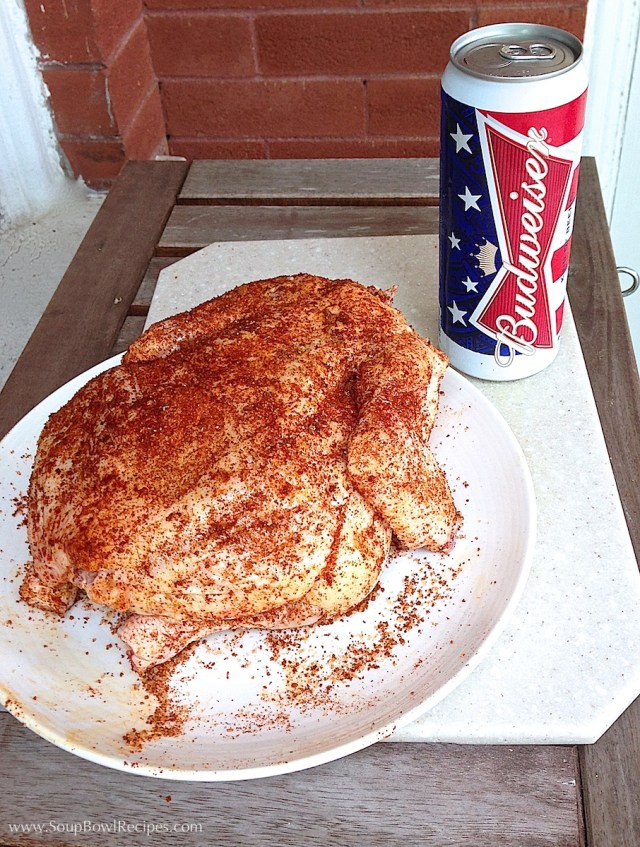
Now here’s a chicken that has `Merica written all over it: cajun spices, a grill, and beer – not to mention the crude jokes that will inevitably follow once you shove the beer can up it’s…well, can, for lack of a better term. But cooking the chicken this way provides more than just a good laugh, it keeps the meat moist and raises the bird up off the fire allowing the skin to get nice and crispy it without burning or sticking to the grate.
This is me last summer with my first attempt at beer can chicken, and since then I’ve cooked close to two dozen of these tasty hens. It took me a few tries to fine tune the spice rub and perfect the cooking method, and in doing so I had to eat pounds and pounds of delicious meat. It’s a dirty job, but someone’s got to do it. You’re welcome. And an unforseen bonus to my family’s repetitive poultry consumption is that this chicken quickly became my toddler’s favorite meal. When I pull the bird out of the fridge in the morning to start brining it, she’ll do her little happy dance (a combination of clapping and jumping) and sing, “It’s the yummy chicken! We’re having the yummy chicken!” (As opposed to all the other non-yummy chickens I make her eat.) And even better is when I put the can inside the chicken and she asks, “Why are you putting soda in his tushy, Mommy?”
Beer Can Chicken
Serves 4-6
- 1 5-6 lb. whole chicken, neck and gizzards removed
- 1 12oz. can of beer, a lager or amber works best (and if you’re able to get your hands on a local brew, even better!)
- ½ cup Kosher salt
- ⅓ cup brown sugar
- ¼ cup sweet paprika
- 2 Tbsp. cayenne pepper (And don’t skimp on the cayenne, I swear it doesn’t make the chicken too spicy)
- 1 tsp. cinnamon
- ½ tsp. garlic powder
- 4 cloves garlic, crushed
- 13×9-inch disposable tin baking dish
- 1 gallon resealable plastic bag
To make the brine and spice rub, combine salt, sugar, and all spices (but not garlic cloves) in a large bowl and mix with a fork.
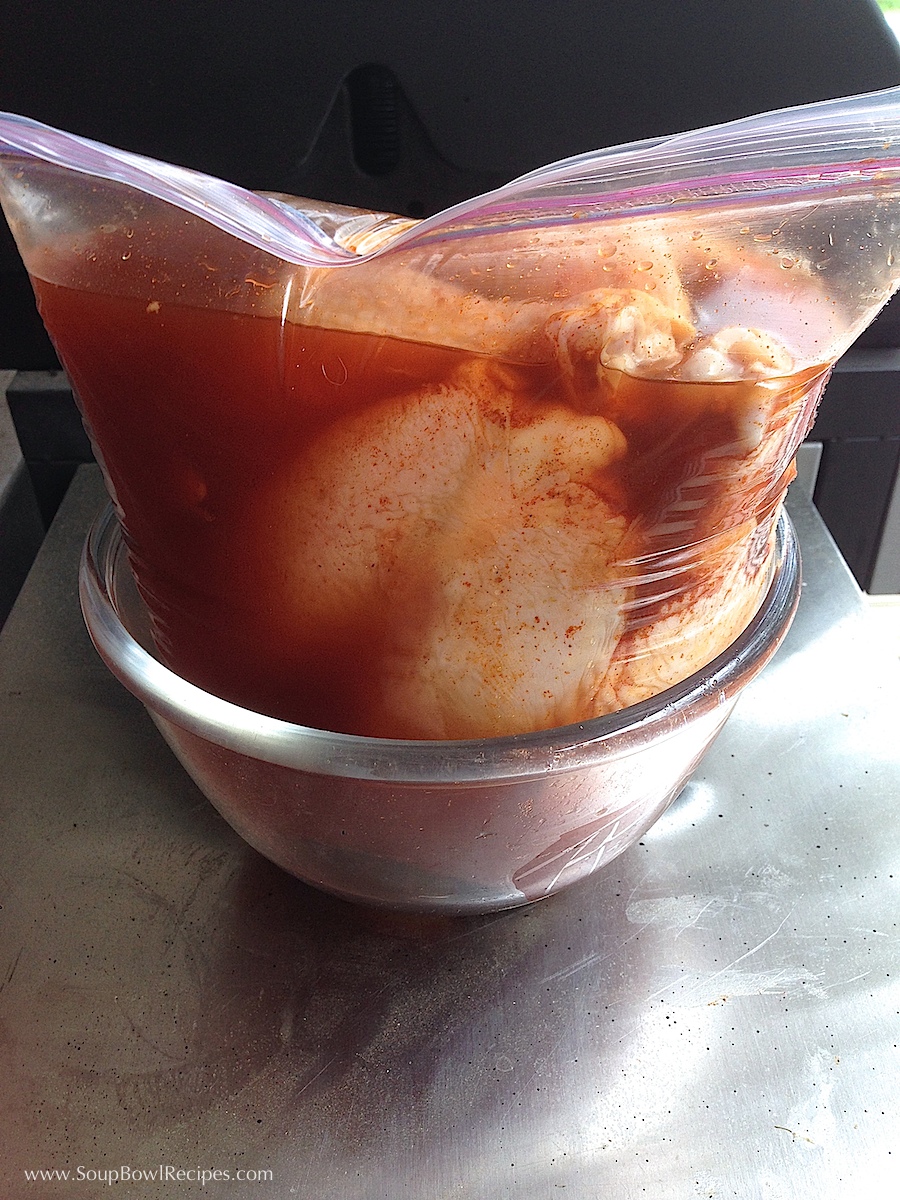
Place chicken in a plastic bag set inside a bowl big enough to hold it. Set aside. (Folding over the edges of the bag makes it easier to pour in the brine.)
In a medium sauce pan, bring 4 cups of water to a boil. Reduce heat to low and add garlic cloves and ½ of spice mixture, about ¾ cup (reserve remaining spice mixture to rub on chicken before grilling). Simmer, stirring occasionally, until salt and sugar have dissolved, about 5 minutes.
Remove from heat and add 2 cups of ice. Let sit until liquid has come to room temperature, it’s okay if the ice hasn’t melted all the way.
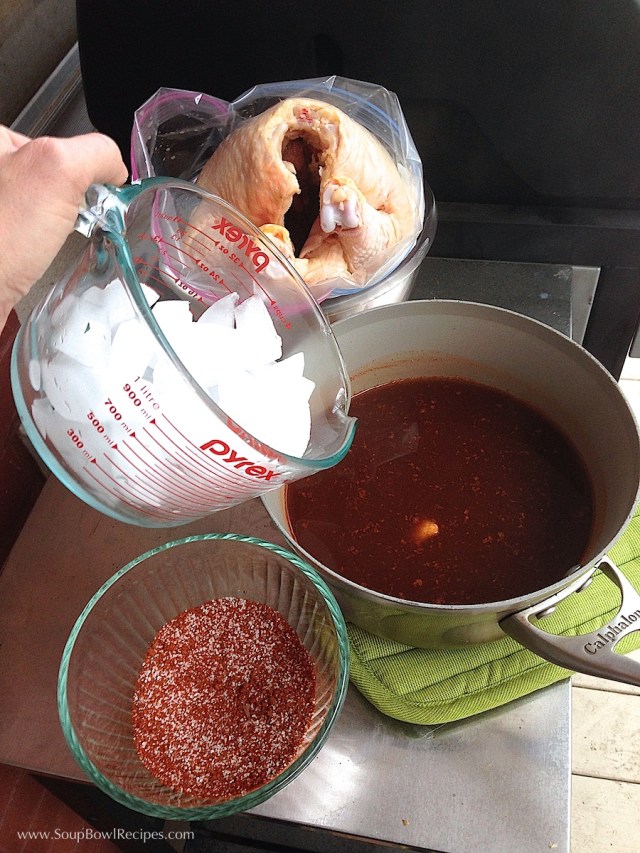
Using a large measuring cup, carefully pour brining liquid and garlic cloves into plastic bag with chicken until liquid almost reaches the top of the bag. Fold the edge of the bag back over and seal the zip lock. Place the bag and bowl in the refrigerator for 8-12 hours. (Brining the chicken is a key step in helping preserve its moisture and flavor under the high heat, so don’t skip this step, people! Seriously, it only takes about 5-10 minutes of prep time in the morning.)
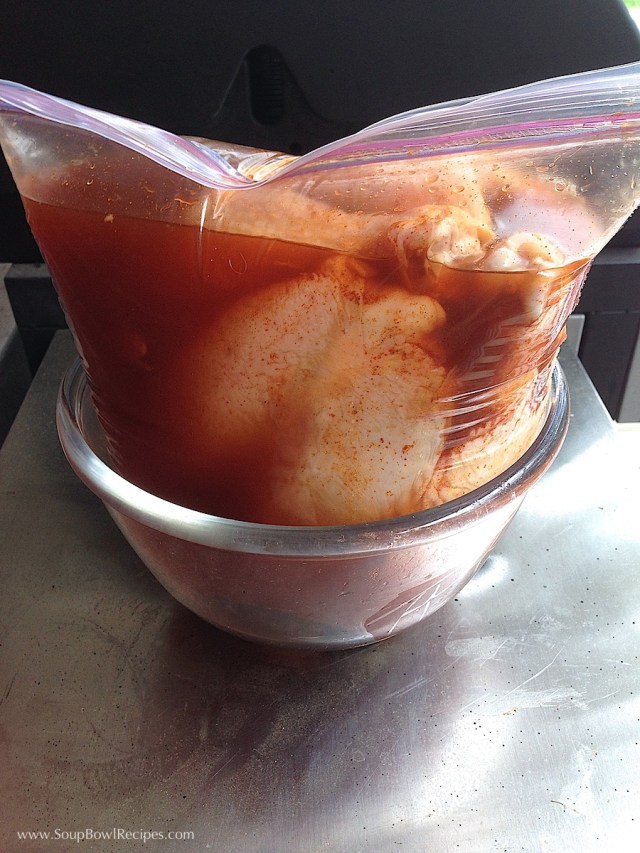
Once chicken has finished brining, remove from liquid and pat dry with a paper towel.
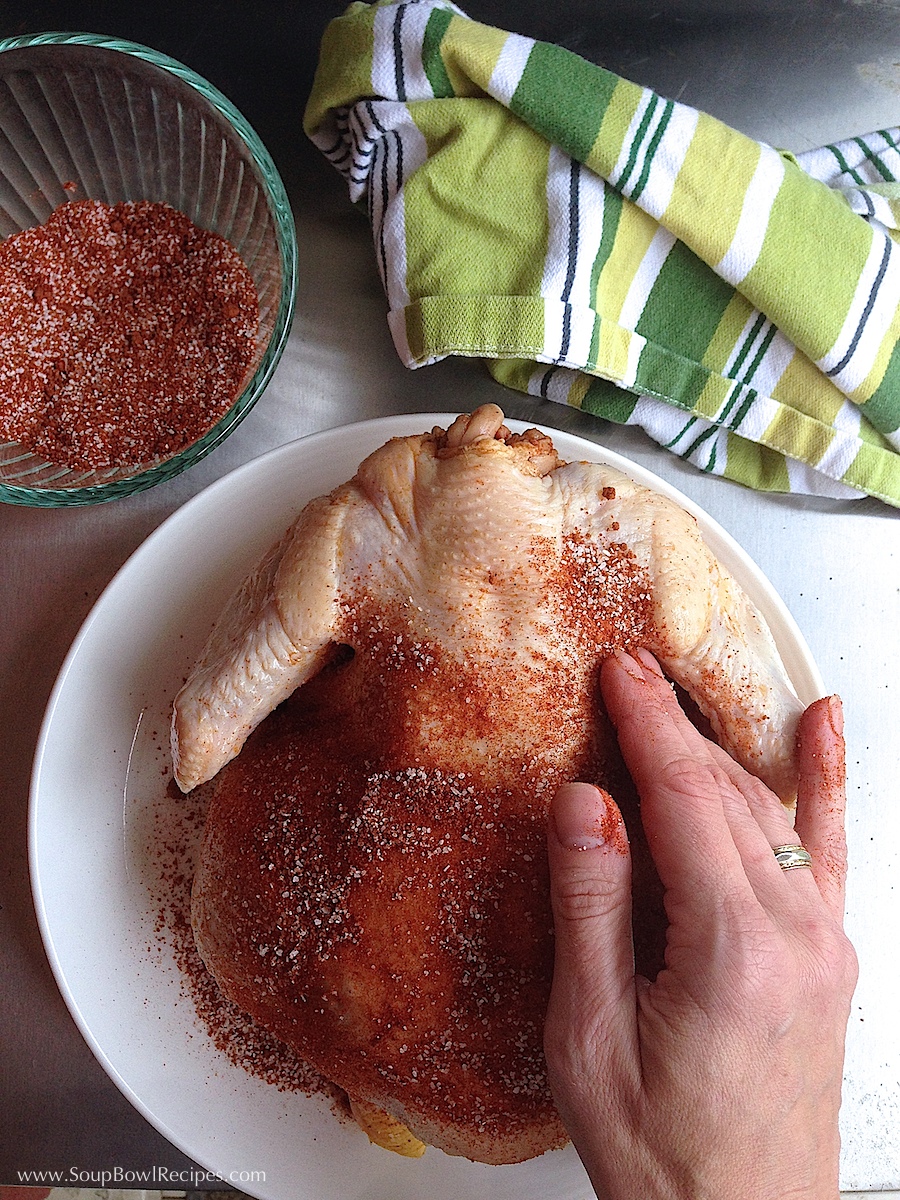
Rub the remaining spice mixture all over chicken, making sure to completely cover both sides, under wings, and in all the other cracks and crevices.
Prepare grill for high, indirect heat:
For a gas grill, lift the grate and place the disposable tin baking pan to one side of the grill, then fill the pan half-way with water (this will keep the drippings from starting a grease fire in your grill). Turn on all but 1 burner (the one under the baking pan). Replace grate. Close the lid and allow the internal temperature to reach 350-400°F before cooking chicken.
For a charcoal grill, lift the grate and push the coals to one side of the grill, baking up the side, and place a disposable tin baking pan on the other side. Fill the pan half-way full of water, then light coals and replace grate. Close lid and allow the internal temperature to reach 350-400°F before cooking chicken.
{Note: If you have a top warming rack like is pictured here, you’ll want to remove it otherwise it will knock the chicken over when you try to shut the lid. Which is a big mess. Just trust me on this one.}
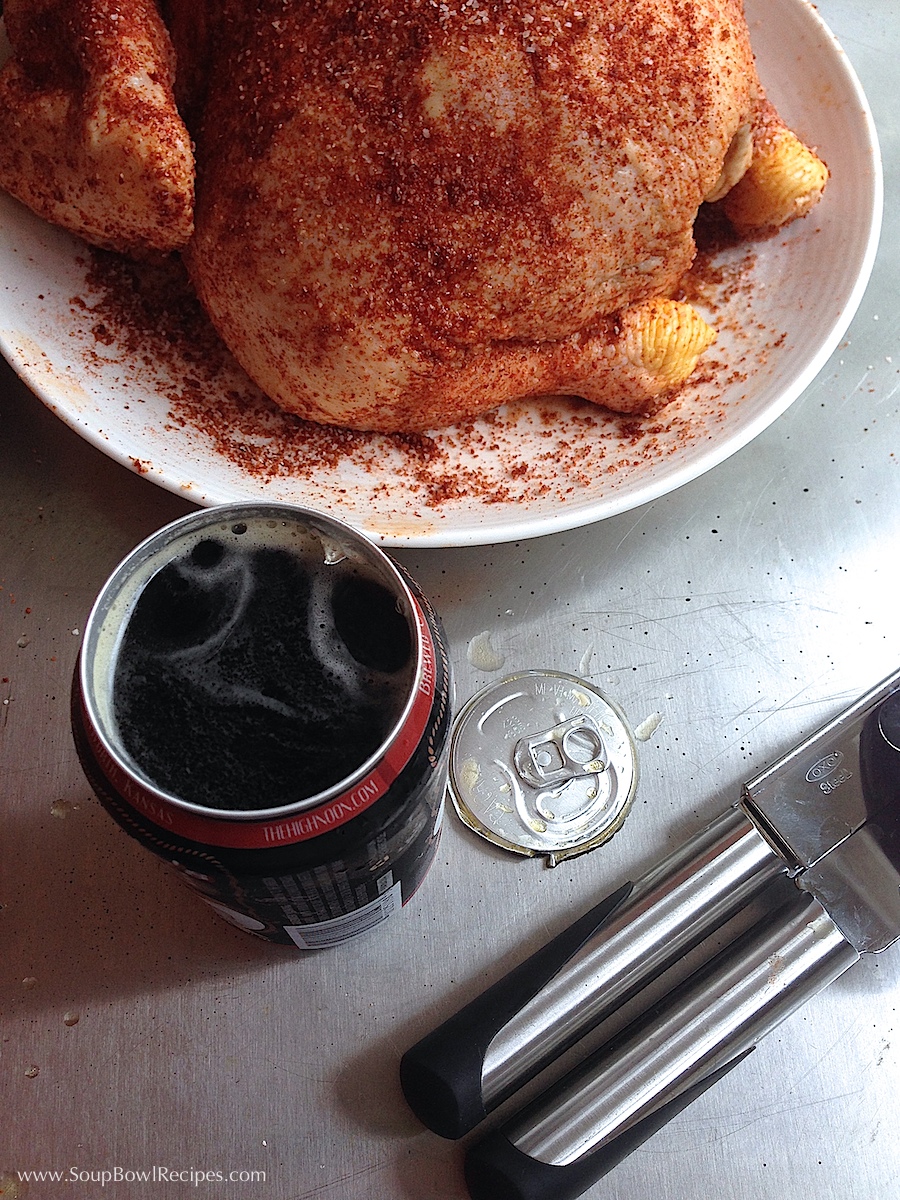
Meanwhile, use a can opener to remove the top of beer can and pour out ½ of the beer into a glass. (I strongly advise drinking the extra beer before proceeding.)
{In case you were wondering, I didn’t suddenly grow hair on my knuckles, these are my husband’s incredibly masculine hands.}
Slide the ½-full beer can into the cavity of the chicken, legs pointing down (now here’s where the jokes start).
Carefully place chicken and can on the indirect portion of the grill over the drip pan. You may need to position the legs like a tripod to stabilize chicken. Close the lid and cook.
Okay, so every chicken recipe I’ve ever run across says, “Cook chicken until an instant-read meat thermometer inserted into the thickest part of the thigh reads 165F.”
That’s fine, however, I’ve found that the chicken isn’t always cooked through when I rely on this method, so in addition to inserting a thermometer into the thigh, I also insert one in the top of the breast, like so…
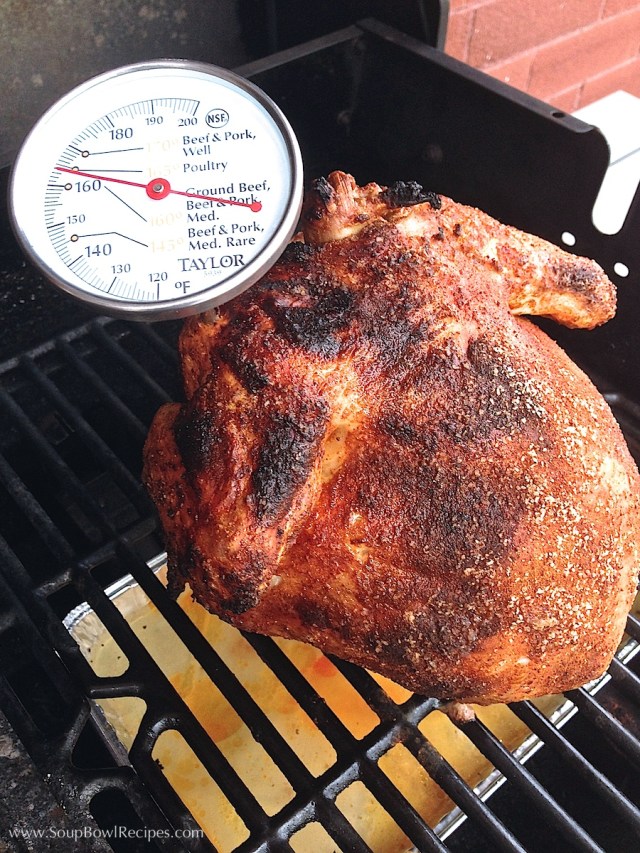
If the temperature here also reads 165°F, then you’re good to go. With a 5-6 lb. chicken, cooking at 350-400°F, and a train leaving Station A at 6 o’clock, this will take about 45-65 minutes. (If using charcoal, you may need to add more to maintain heat.)
Transfer chicken to a plate and allow to rest for 10 minutes before carefully removing the beer can and carving. (Don’t dump the beer just yet, because if you slice into the chicken and it’s not quite done, you’ll want to pop it back on the can and put the whole shebang back on the grill a little while longer until cooked through.)
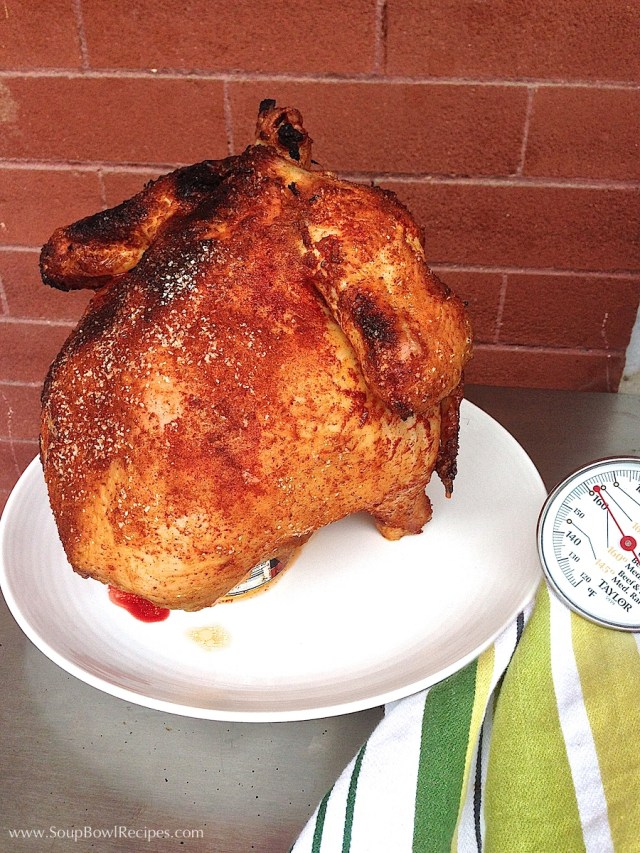
Sidekicks: Serve with beer, of course, and a couple of these grilled sides. While the chicken is resting, throw these veggies onto your hot grill and everything will be ready at the same time. Brilliant!
Lemony-Garlic Asparagus
The acidity of the lemon and the sweetness of the asparagus are an excellent counter to the slightly salty, slightly spicy chicken. And the garlic? Well, I added that just because I love garlic.
Lemony-Garlic Asparagus
Serves 4
- 1 bunch of asparagus, tender parts only
- 3 Tbsp. unsalted butter, melted
- 1 clove garlic, minced
- juice of 1 lemon
- Kosher salt and fresh cracked pepper to taste
In a small bowl, combine butter, garlic, and lemon juice. Whisk until combined. Line a grill tray with a piece of tin foil (you don’t want all those delicious juices to be lost to the fire), and place asparagus on foil in a single layer. Drizzle with butter mixture and season with salt & pepper.
Place basket on grill set to high heat, close lid and cook for 2-3 minutes or until crisp-tender and the tips start to brown. Transfer to a plate and serve immediately.
Grilled Avocados with Salt and Lime
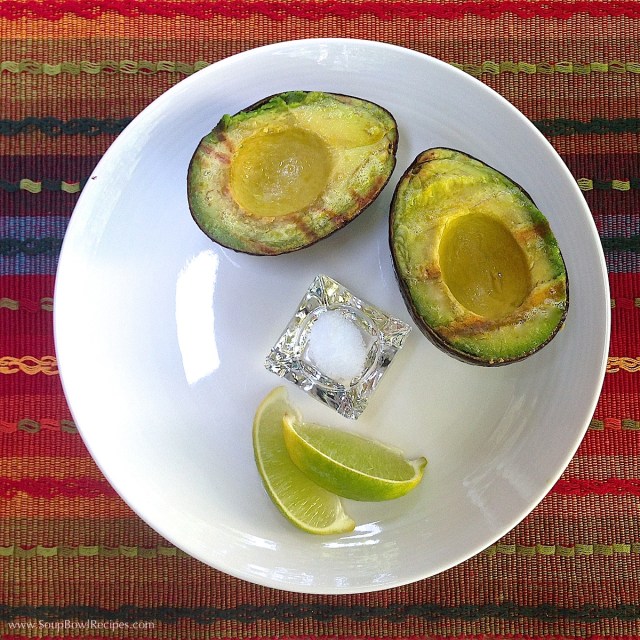
Now I like guacamole as much as the next gal, but this is hands down my favorite way to eat an avocado — and it’s probably the easiest side dish in the history side dishes. (Recipe slightly adapted from Bon Appétit)
Grilled Avocados with Salt and Lime
Serves 4-6
- 2-3 ripe avocados, halved with pit removed
- 1-2 Tbsp. olive oil
- 4-6 lime wedges
- Kosher salt to taste
Brush each avocado half with oil, and mist the grill grate with high heat cooking spray. Place avocados flesh-side down on a grill set to high heat. Cover and cook for 3-5 minutes or until avocado easily lifts from grate and has sear marks. Serve with a squeeze of lime and a sprinkle of salt.
Stuff My Kid Eats: Roasted Cauliflower and Goat Cheese Frittata
Stuff My Kid (Mostly) Eats
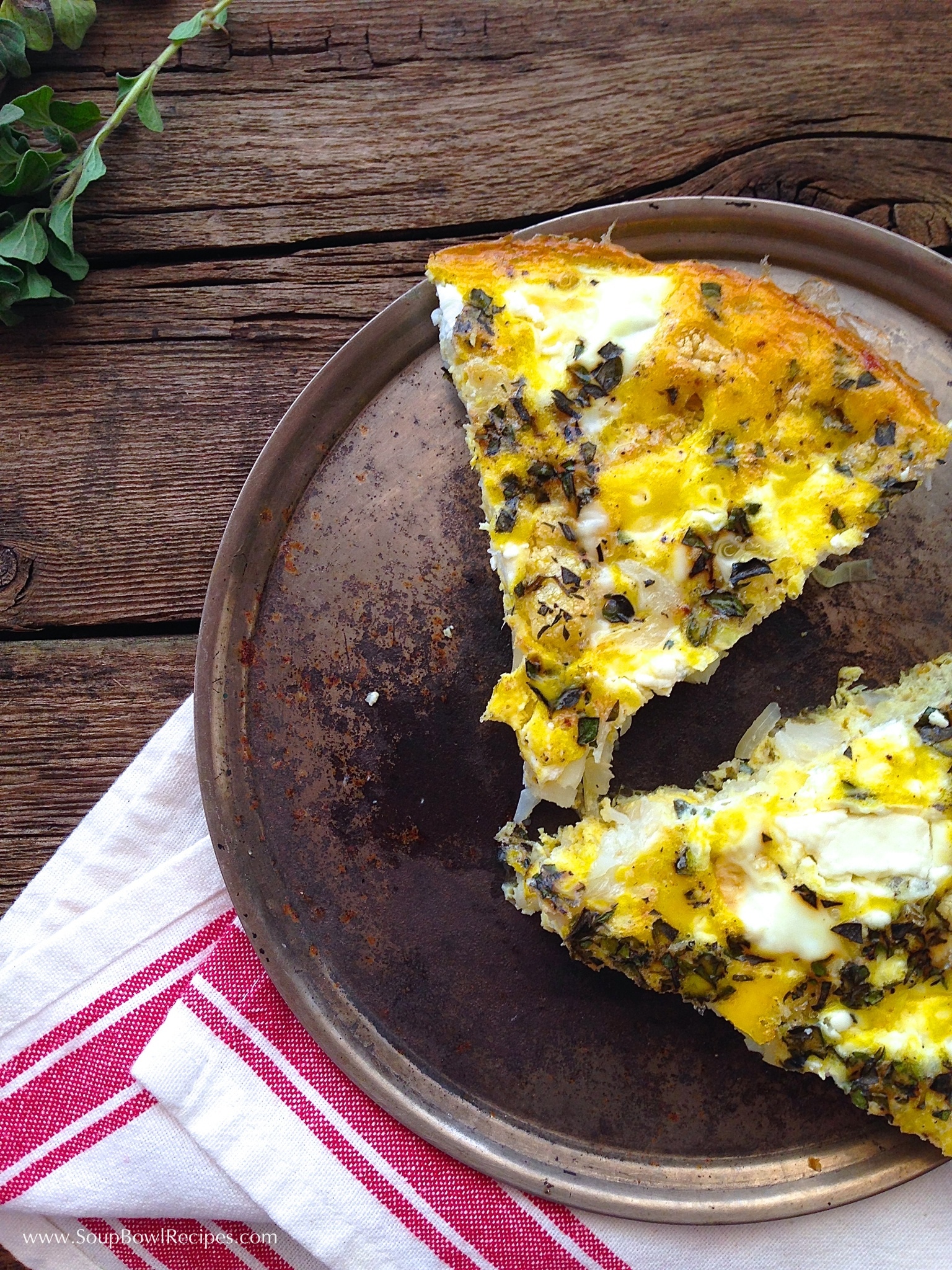
Now before you go saying: “Whaaaaatever! There’s no way her toddler eats that! My kid would never eat roasted cauliflower!” Well, she didn’t, not technically. She ate the entire slice of frittata that I gave her, yet somehow managed to ferret out every little piece of cauliflower in it. At the end of the meal, there was a very sad looking pile of mutilated white stuff at the edge of her plate which she pointed to and firmly said “NO!” So there it is. That is my disclaimer. My kid doesn’t eat everything! At any rate, the meal was great, my husband and I loved it, and you could easily substitute the cauliflower for another vegetable that won’t cause a juvenile uprising at the dinner table. (Recipe slightly adapted from Fine Cooking.)
Roasted Cauliflower and Goat Cheese Frittata
The beauty of this dish is that the ingredients can be adapted to fit your taste, AND it works well for breakfast, lunch, or dinner!
Roasted Cauliflower and Goat Cheese Frittata
- 1 small red or yellow onion, halved and thinly sliced lengthwise
- 2 Tbsp. distilled white vinegar
- Kosher salt
- 2 cups cauliflower florets (about ½ small head), cut into 1-inch pieces, or 2 cups of another favorite vegetable
- 2 Tbsp. plus 2 tsp. olive oil
- Freshly ground black pepper
- 8 large eggs
- 2 Tbsp. chopped fresh herbs (oregano, thyme, parsley, dill, etc.)
- ½ tsp. whole-grain mustard
- 2 Tbsp. unsalted butter
- 6 oz. fresh goat cheese, crumbled, about 1 ½ cups, or 6 oz. of another cheese of your choosing (Oh, I just love alliteration!)
Position a rack about 6 inches from the broiler and heat the broiler on high.
Combine the onion, vinegar, and ½ tsp. salt in a small bowl; let sit for 10 minutes and then drain and pat the onion dry. Set aside.
Meanwhile, on a large rimmed baking sheet, toss the cauliflower (or another vegetable) with 2 tsp. of the oil, ½ tsp. salt, and ¼ tsp. pepper. Broil, tossing once or twice, until the edges are golden, 3 to 6 minutes.
Reposition rack in the center of the oven and set the oven to 400°F.
Whisk the eggs, herbs, mustard, ½ tsp. salt, and ½ tsp. pepper in a medium bowl.
Heat the remaining 2 Tbsp. oil and the butter in a 12-inch ovenproof skillet over medium-high heat until the butter melts. Add the onion and cook, stirring occasionally, until some of the pieces are dark golden brown, about 3 minutes. Remove the skillet from the heat, stir in the roasted cauliflower, and then slowly pour in the egg mixture, redistributing the vegetables evenly. Sprinkle the cheese on top and bake until the eggs are set in the center, about 10-15 minutes. Let rest for 5 minutes and then use a silicone spatula to slide the frittata onto a serving plate or cutting board. Slice into wedges and serve.
Sidekick: Serve with a crisp dry white wine like a Chablis, or an Italian dry white like a Soave or Gavi di Gavi.
Dublin Coddle Crockpot Version!
Hey, everybody! I just did a little online research and found out that you can make yesterday’s Dublin Coddle in your crockpot as well, here’s how:
- 1 lb. bacon strips
- 8 good-quality port sausages
- 4 onion, sliced
- 1 leek, some green tops included, sliced
- 2 bay leaves
- 2 sprigs thyme
- ¼ cup chopped fresh parsley
- 2 garlic cloves, chopped
- 6 starchy potatoes, such as russets, peeled and cut into 2 or 3 large chucks
- 1 cup chicken stock
- Fresh cracked black pepper
In a large skillet, cook bacon until just starting to crips. Transfer to a paper towel lined plate. Let cool, then slice in thirds widthwise, set aside.
In the same skillet over medium heat, add the sausages to the bacon fat and cook, turning, for about 15 minutes, until evenly browned. Transfer to a cutting board and cut into thirds, widthwise, set aside.
Also in the same skillet, gently cook the onions for 7-8 minutes, until soft but not colored.
Layer the onions, sausages, and bacon in your crockpot, seasoning each layer with plenty of black pepper. Add the leek, herbs, and garlic, and finish with a layer of potatoes. Season with a little more black pepper, then pour in the stock. cook at high (4 hours) or low setting (8 hours) until done.
Dublin Coddle
Dublin Coddle
Dublin Coddle is a traditional Irish comfort food that dates back to the seventeenth century. Because practicing Catholics are prohibited from eating meat on Fridays during Lent, it is thought that this dish came about as a way to cook up leftover meat at the end of the week. The first time I tried it was at an Irish Festival in Weston, MO and I was surprised at how flavorful it was for its simple ingredients – onions, potatoes, sausage, and bacon – but wow, I was impressed! Ever since then Dublin Coddle has singlehandedly replaced Chicken Pot Pie as my all-time favorite Irish meal! (Recipe slightly adapted from The Complete Irish Pub Cookbook)
Serves 4-6
- 1 lb. bacon strips
- 8 good-quality port sausages
- 4 onion, sliced
- 1 leek, some green tops included, sliced
- 2 bay leaves
- 2 sprigs thyme
- ¼ cup chopped fresh parsley
- 2 garlic cloves, chopped
- 6 starchy potatoes, such as russets, peeled and cut into 2 or 3 large chucks
- 3 cups chicken stock
- Fresh cracked black pepper
Preheat oven to 300°F. In a large skillet, cook bacon until just starting to crips. Transfer to a paper towel lined plate. Let cool, then slice in thirds widthwise, set aside.
In the same skillet over medium heat, add the sausages to the bacon fat and cook, turning, for about 15 minutes, until evenly browned. Transfer to a cutting board and cut into thirds, widthwise, set aside.
Also in the same skillet, gently cook the onions for 7-8 minutes, until soft but not colored.
Layer the onions, sausages, and bacon in the bottom of an oven/flame proof casserole dish (or Dutch oven) with a lid, seasoning each layer with plenty of black pepper. Add the leek, herbs, and garlic, and finish with a layer of potatoes. Season with a little more black pepper, then pour in the stock.
Cover the casserole dish tightly and bring to a boil on top of the stove. Transfer to the preheated oven and cook for 45 minutes, or until the potatoes are tender.
Sidekicks: Serve with plenty of dark Irish soda bread to mop up the juices and a Guinness.